Delivery
Choosing a courier in Pakistan
Your courier decides when your COD cash reaches you, which towns you can deliver to and how many parcels come back. Compare couriers on full cost, payout timing, coverage and returns, not just the rate per parcel.
Most online brands in Pakistan sell with cash on delivery, so your courier does more than carry the parcel. It collects your money at the door and decides when that money reaches your bank. A courier that is a little cheaper per parcel but pays you a week later, or returns more parcels, can cost you more in the end.
The best courier for you depends on where your buyers are, what you sell, how many parcels you send and how long you can wait for your cash. Below is what to compare, and the questions a rate card will not answer.
What to compare
Ask each courier on your list the same questions, in writing, so you can line the answers up side by side.
| What to compare | Why it matters | What to ask for |
|---|---|---|
| Rate per weight slab | Most parcels are charged by the half kilo or kilo. Small clothing parcels and heavy home goods land in very different slabs. | The full slab table, not only the first slab. |
| Same city and intercity | Rates and delivery times differ between your own city, other big cities and smaller towns. | Rates and transit days for each zone. |
| Volumetric weight | Light but bulky parcels are charged by size, not weight. | The formula they use and the size limit for a standard parcel. |
| COD fee | Collecting cash usually carries its own fee, either fixed or a percentage of the order. | Whether it is fixed or a percentage, and whether it changes with order value. |
| Extra charges | Fuel surcharge, taxes and insurance can be added on top of the rate. | Every charge that appears on the invoice, with an example invoice. |
| Payout schedule | How long the courier keeps your cash after delivery. | How often they pay, which account the money goes into, and any minimum payout. |
| Return charges | When a buyer refuses a COD parcel, you may pay for the trip there and back. | The charge for a returned parcel and how long returns take to reach you. |
| Coverage | Many couriers are slower in smaller towns, or do not deliver there at all. | A list of cities and areas they cover, and which are served by a partner. |
| Pickup and booking | A daily pickup from your door saves you a trip to drop parcels off. | Pickup times, minimum parcels for pickup and how you book. |
| Claims and tracking | Parcels do get lost or damaged; you need a way to claim and a link to share. | The claims process, time limits, and the tracking page buyers will see. |
Payout timing is as important as price
With cash on delivery, the courier collects your money and keeps it until the next payout. If you send 300 parcels a month at an average of Rs 3,500, every extra week of waiting leaves roughly Rs 2,40,000 stuck with the courier instead of going into stock or ads.
Some pay weekly: Leopards says its retail COD sellers receive weekly disbursements directly to their bank account. PostEx advertises instant upfront payments. Ask which day the money actually lands in your account, and whether a faster payout costs extra.
What couriers publish about themselves
Few couriers publish complete rate cards, and most terms are set when you open an account. Here is what a few of them say on their own websites today. Use it to plan your questions; it does not compare prices.
| Courier | Cash on delivery | Paying you | Network |
|---|---|---|---|
| Leopards | Calls itself Pakistan's leading cash on delivery service provider; offers an e-commerce account. | Weekly COD disbursements to your bank account for retail COD sellers. | Describes a nationwide delivery network. |
| PostEx | Delivers COD orders nationwide for online sellers. | Advertises instant upfront payments. | Nationwide. |
| M&P | Offers corporate and retail COD accounts, with a COD portal. | Not stated on its home page. | 750+ courier centres in Pakistan. |
Questions to ask before you sign
Sales teams are used to hearing "what is your rate?" Also ask what happens when things go wrong: refused parcels, lost parcels and late payouts.
- What is the full rate for my usual parcel, including every surcharge and tax, for same city, other cities and small towns?
- What is the COD fee, and is it fixed or a percentage of the order value?
- When exactly do I get paid after a parcel is delivered, and into which account?
- What do you charge when a buyer refuses a parcel, and how many days until it is back with me?
- How many delivery attempts do you make, and do riders call the buyer first?
- Which areas do you deliver to yourselves, and which go through a partner?
- What are your pickup times, and is there a minimum number of parcels?
- How do I claim for a lost or damaged parcel, and what proof do you need?
- What does the tracking page show, and does the link work without logging in?
- Can you share a sample invoice for a month like mine?
Assalam o alaikum. I run Noor Threads, an online clothing brand in Lahore.
We send about 300 parcels a month, mostly 0.5 to 1 kg, about 70% cash on delivery and 40% outside Lahore.
Could you share your full rate slabs for same city and intercity, the COD fee, return charges, your payout schedule and the documents you need to open an e-commerce account?
A sample invoice would help us compare. Thank you.
Couriers quote more accurately when you send real numbers, and sales teams often have more room on price, payout timing and pickup for a seller who knows their monthly volume.
Opening an account
Most couriers have a separate account type for online sellers, often called an e-commerce or COD account, that comes with a portal for booking parcels and seeing payments. Leopards lists an e-commerce account alongside corporate accounts, and M&P has a cash on delivery account type and a COD portal.
Each courier asks for its own documents, and the list can change, so ask for the current one. Have your CNIC, your business details and the bank account you want payments sent to ready before you call. If you have a registered business and a bank account in its name, use it from the start: changing the payout account later usually means more paperwork.
When to use two couriers
Many growing brands end up with two couriers. It is more admin, but if one courier has a slow week your orders keep moving, and you can give each one the areas it serves best.
- By region. One courier for your own city and big cities where it is fast and cheap, another for smaller towns where its own network reaches further.
- By order type. One for cash on delivery orders, another for prepaid orders where the COD fee and payout speed matter less.
- As a backup. Keep a second account active with a few parcels a month, so you can switch quickly during a strike, the Eid rush or a run of problems with your main courier.
Keep a simple record of delivered and returned parcels for each courier by city. After two or three months you will know which courier does better in which city.
Telling buyers when their order will arrive
Buyers plan around the delivery time you show, so work it out from two numbers: your own dispatch time and the courier's transit time.
Measure your dispatch time
Count the days from when an order comes in to when you hand the parcel to the courier. Include confirmation calls and stitching or packing time. If you dispatch the next working day, that is one day.
Add the courier's transit time by zone
Use the transit days the courier gave you for same city, other big cities and smaller towns, then check them against your trial week.
Publish a range of days
Add the two and give a range: for example 2 to 3 working days in Lahore and 3 to 5 working days elsewhere. Pick a range you can meet in a normal week, not the fastest time you have ever managed.
Show it on your store
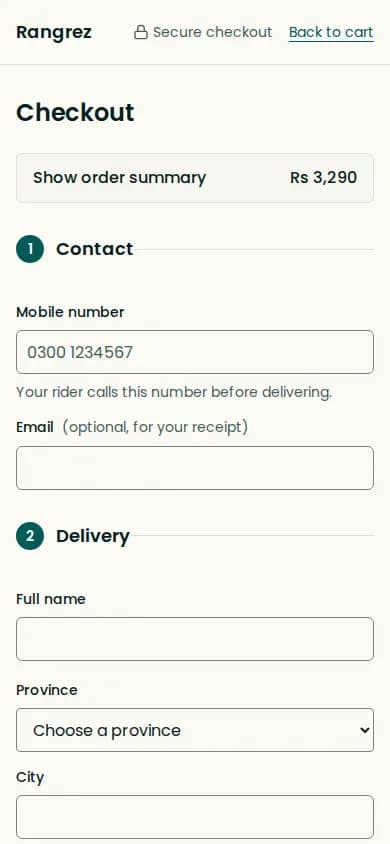
Put the range on your shipping policy page, near the price on product pages, and at checkout. Mention busy periods such as Eid and big sales, when every courier slows down.
On devhelp, you set shipping zones by province. Each zone has its own rate and delivery-days range, and you can add a free-shipping threshold if you want one. Buyers see the right delivery charge at checkout for their address, and your shipping policy page starts as a draft you can edit to match the ranges you promise.
Adding your courier to devhelp
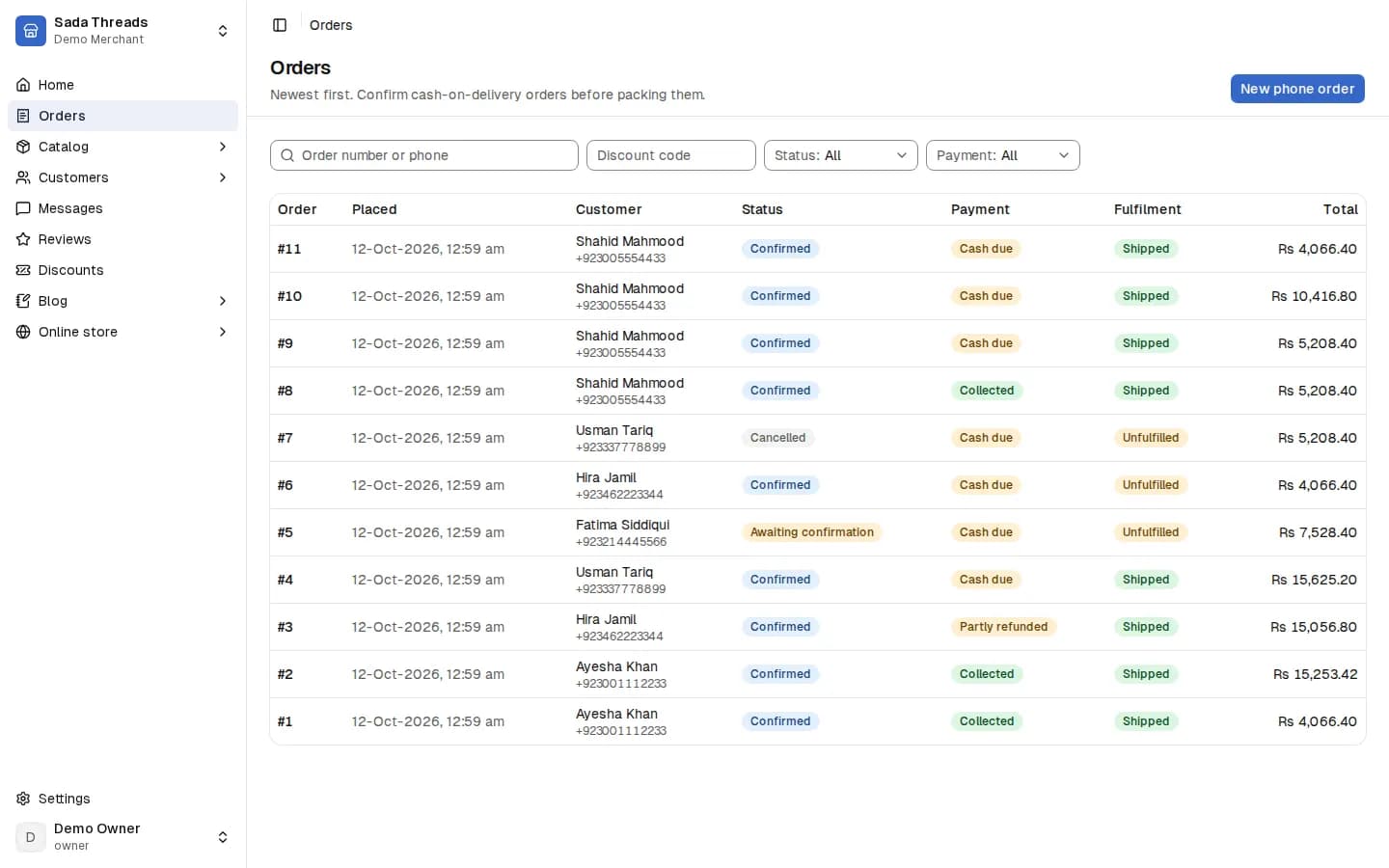
devhelp does not book parcels with couriers for you; you keep using your courier's own portal for that. devhelp saves the courier and tracking number on each order, so you and your buyer have the tracking link to hand.
Add the courier as a delivery service
In your dashboard, add each courier you use: its name and a tracking link template. That is the address of the courier's tracking page, with a marker where the tracking number goes.
Record the parcel when you book it
When you book a parcel on your courier's portal, create the parcel in devhelp, choose the courier and enter the tracking number from that booking.
Share the tracking link
devhelp builds the tracking link for that parcel from your template, so the buyer can track their parcel. Share it with them when you let them know the order is on its way.
Record what happens next
Mark the parcel delivered, or returned when a refused parcel comes back. Returned stock goes back into your inventory, and the buyer's history shows how many orders they have refused.
To add up the courier, COD and return charges on one order, read what one delivered COD order really costs. To bring the number of refused parcels down, see cutting COD refusals and returned parcels.
Before you choose
- Asked at least two couriers the same questions, in writing
- Compared the full cost of a delivered and a returned parcel, not just the first slab
- Checked when payouts arrive and which bank account they go into
- Confirmed coverage for the smaller towns your buyers order from
- Run a trial week including a few parcels outside your city
- Published a delivery-time range on your store
- Added the courier and its tracking link template in your dashboard
Common mistakes
- Choosing on the first weight slab alone and being surprised by surcharges, COD fees and return charges on the invoice.
- Using a large box for a light item and paying for volumetric weight.
- Promising next-day delivery everywhere when your courier is slower outside big cities.
- Having COD payouts sent to a personal bank account, then having to switch them to a business account later.
- Never checking delivered and returned parcels by courier and city, so a poor route goes unnoticed for months.
Questions
Which courier is best for a small online store in Pakistan?
Compare at least two on full cost, payout timing, coverage and returns, then run a trial week before committing. The best fit depends on where your buyers are, what you sell and how quickly you need cash back.
Do couriers charge for returned COD parcels?
Return charges vary by courier and account. Ask what a refused parcel costs, including the return trip, and how many days it takes to come back to you.
How quickly will I receive my cash on delivery money?
Each courier sets its own payout schedule. Some pay weekly; others advertise faster or upfront payments, sometimes for a fee. Confirm the schedule before you sign.
Can I use more than one courier?
Yes. Many brands use one courier for their own city and another for smaller towns, or keep a second account as a backup for busy periods.
Does devhelp book parcels with my courier?
Not today. You book with your courier as usual, then record the courier and tracking number on the parcel in devhelp so the buyer gets a tracking link.
What delivery time should I show on my store?
Add your own dispatch time to the courier's transit time for each area and show a range, such as 3 to 5 working days.
Sources
- Leopards Courier, E-commerce economy service · accessed
- Leopards Courier, Pakistan home page · accessed
- PostEx home page · accessed
- M&P (Muller & Phipps) home page · accessed