Cash on delivery
What one delivered COD order costs you
A worked example in rupees: the product, the packaging, the courier, the COD fee, the tax the courier keeps, and the parcels that come back.
Many Pakistani shoppers ask to pay cash on delivery, and saying yes is easy. The money that reaches your bank account is less than the price on your product page, though. A courier charge, a COD fee and a tax deduction come off first, and some parcels come back without being paid for at all.
Below, we follow one kurta order from your page to your bank account, then see what returned parcels do to it. Every figure comes from the same example, with numbers typical for a small clothing brand. Put your own in as you go.
The example order
A shopper in Lahore orders a cotton kurta priced at Rs 3,500. The store charges Rs 200 for delivery, so the shopper pays the rider Rs 3,700 at the door. We call this the door total. It is what the rider collects, and most fees are worked out on it.
| Item | How it is worked out | Amount |
|---|---|---|
| Door total collected | Rs 3,500 price + Rs 200 delivery | Rs 3,700 |
| Product cost | What you paid to make or buy the kurta | − Rs 1,600 |
| Packaging | Flyer, tissue, label, thank-you card | − Rs 80 |
| Courier delivery charge | Example intercity rate for a 0.5–1 kg parcel | − Rs 250 |
| COD fee | Example of 1% of the amount collected | − Rs 37 |
| Income tax deducted by the courier | 2% of Rs 3,700 for a seller on the Active Taxpayers List | − Rs 74 |
| What you keep | Before rent, salaries and advertising | Rs 1,659 |
On paper the kurta has a margin of Rs 1,900 (Rs 3,500 minus Rs 1,600). After delivery, packaging, the COD fee and tax, you keep Rs 1,659. Returned parcels, covered below, take more off.
Courier charges and COD fees
Couriers charge for each parcel by weight and route, and most charge a separate fee for collecting cash. The large couriers publish only part of their pricing and agree the rest with each business, so treat the figures below as rough ranges and ask for your own rates.
| Courier | 0.5–1 kg within a city | 1 kg between major cities | COD fee | Typical payout |
|---|---|---|---|---|
| Leopards | Rs 170–220 | Rs 230–260 | Rs 100–150, or about 1% | 7–10 working days |
| TCS | Rs 200–300 | Rs 275–330 | About 1.5%, or Rs 125–200 | 7–14 working days |
| PostEx | Agreed per account | Agreed per account | Agreed per account | Often faster, by agreement |
| Trax | Agreed per account | Agreed per account | About 2–3% | 7–10 days |
On any rate card, check whether the COD fee is flat or a percentage, since a percentage costs more on expensive items. Check what returned parcels are charged, and whether fuel surcharge and tax are added on top. Our guide to choosing a courier covers what else to compare.
The tax the courier keeps
Since the Finance Act 2025, couriers that collect cash for goods ordered online deduct income tax before they pay you, under section 153(2A) of the Income Tax Ordinance. On FBR’s withholding tax rate card, the deduction on cash collected by a courier is 2% of the gross amount for sellers on the Active Taxpayers List and 4% for sellers who are not. For orders paid online through a bank or payment gateway, the listed rate is 1% for sellers on the list and 2% for those who are not.
Couriers also have to handle sales tax on COD orders for goods ordered online, as FBR’s Circular 02 of 2025-26 explains, and whether that tax is final for you depends on what kind of business you are. FBR treats it as the final sales tax for cottage industry and for retailers other than tier-1 retailers; other businesses adjust it in their sales tax returns. Tax rules change with each budget, so check FBR’s current rate card or speak to a tax adviser for your own situation.
When the money arrives
With cash on delivery you pay for the product, the packaging and the courier before you are paid. The courier then holds the cash it collects until its next payout, typically one to two weeks for the larger couriers. In the meantime you are buying stock for the next orders with your own money.
Say you deliver Rs 3,700 orders every day and your courier pays out ten working days after delivery. Around two weeks of sales are then always in the courier’s hands. At 10 orders a day that is roughly Rs 3.7 lakh you have earned but cannot use yet. Plan your stock purchases around that gap, and ask couriers about faster payout options when you compare them.
What a returned parcel costs
Parcels come back when the buyer refuses them, stops answering the phone or gave an address the rider cannot find. A returned parcel earns nothing, and it still costs you:
- The forward delivery charge. The courier made the trip, so you pay it: Rs 250.
- A return charge. Many couriers charge to bring a parcel back, sometimes at the full delivery rate. Here it is Rs 150.
- The packaging. It usually cannot be reused once it has travelled: Rs 80.
- Time. The item is out of stock for the week or two it is on the road, and someone has to check it and put it back.
So a returned parcel costs Rs 480 in cash, before counting the time. There is no COD fee or tax on it, because no cash was collected.
A quick sum for returns
To see what returns do to your profit, you need three numbers:
- M: what you keep from one delivered order (Rs 1,659 above).
- F: what one returned parcel costs you (Rs 480 above).
- r: the share of dispatched parcels that come back, as a fraction (20% is 0.2).
Profit per delivered order = M − F × r ÷ (1 − r)
At a 20% return rate: 1,659 − 480 × 0.2 ÷ 0.8 = 1,659 − 120 = Rs 1,539
The F × r ÷ (1 − r) part shares the cost of returned parcels across the ones that were delivered. At 20%, every four delivered parcels carry the cost of one that came back.
Now take a cheaper item from the same shop: a cotton dupatta priced at Rs 1,200 that costs Rs 700 to make, with the same Rs 200 delivery charge. The door total is Rs 1,400. Take off Rs 60 for packaging and Rs 250 for the courier, then a Rs 14 COD fee and Rs 28 tax, and you keep Rs 348. A returned dupatta costs Rs 460 (Rs 250 + Rs 150 + Rs 60).
| Return rate | Kurta, Rs 3,500 (M = 1,659, F = 480) | Dupatta, Rs 1,200 (M = 348, F = 460) |
|---|---|---|
| 0% | Rs 1,659 | Rs 348 |
| 10% | Rs 1,606 | Rs 297 |
| 20% | Rs 1,539 | Rs 233 |
| 30% | Rs 1,453 | Rs 151 |
| 40% | Rs 1,339 | Rs 41 |
At 20% returns the kurta barely notices, but the dupatta loses a third of its profit, and at 40% it makes almost nothing. Returns hurt low-priced items most, because the courier charge is a large share of the price. So track your return rate for each product as well as for the whole store. Our guide to cutting COD refusals and returned parcels shows how to measure it.
Pricing delivery and COD fees
Once you know your numbers, decide what the shopper pays and what you absorb. These approaches work for most small stores.
Show delivery as its own line
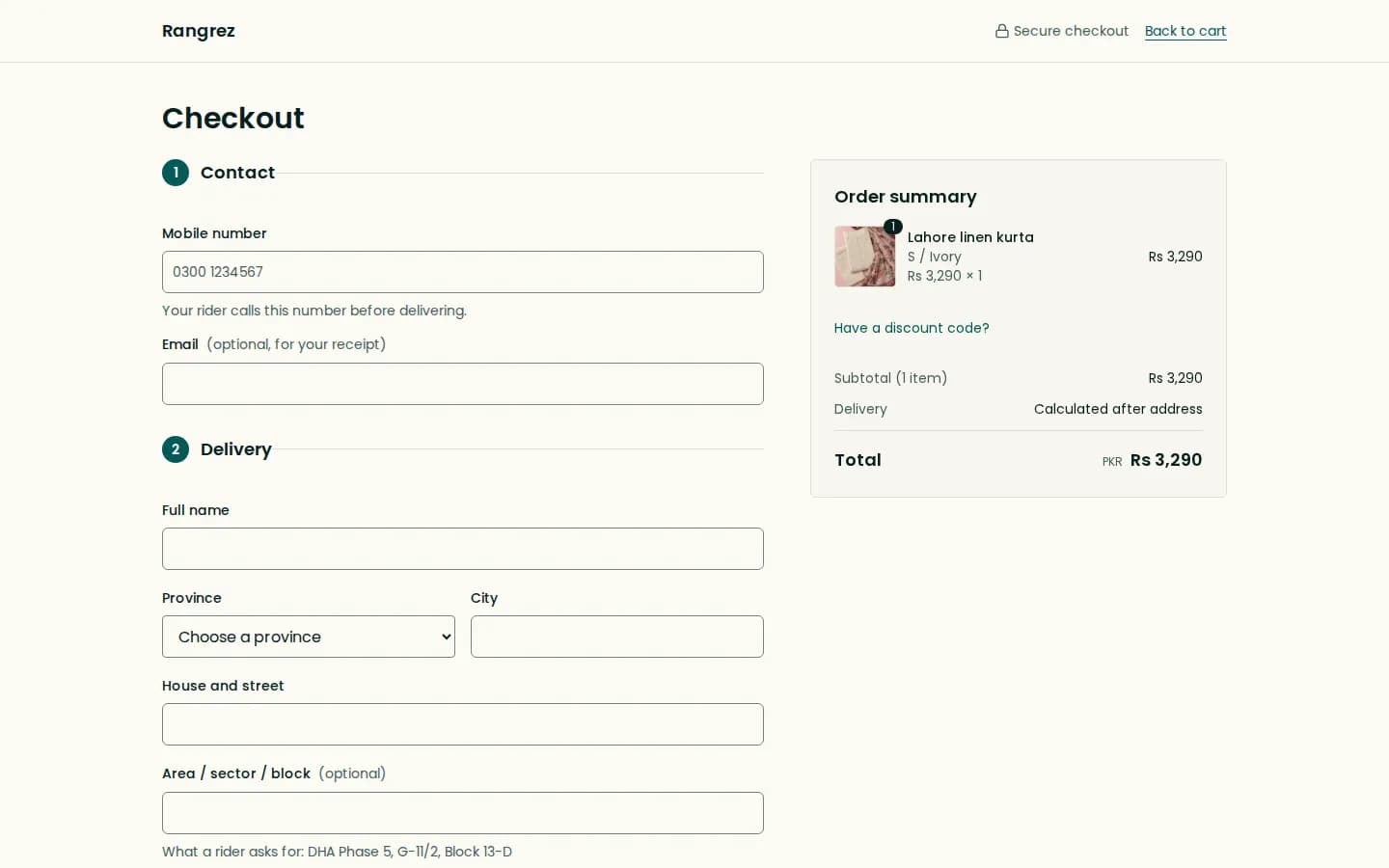
Shoppers often refuse a parcel when the rider asks for a delivery charge they did not expect. Show it at checkout, by province if your courier charges differ, so the door total is never a surprise. In devhelp you set delivery rates by province and the shopper sees the full total before placing the order.
Offer free delivery above an amount, not on every order
Free delivery on every order means a Rs 1,200 item carries a Rs 250 courier charge on its own. Free delivery only above, say, Rs 5,000 encourages bigger orders, and on a bigger order the courier charge is a smaller share of the price. In devhelp you set the amount, and checkout shows the shopper how close they are to free delivery.
Decide whether to charge a COD fee
Some stores add a small fee for paying in cash to cover the courier’s COD charge, and it can nudge shoppers towards paying online. Others keep COD free because a fee can put shoppers off. devhelp lets you add an optional COD fee that is shown at checkout. If you try one, watch your order numbers for a few weeks before deciding.
Compare COD with card payments
Card payments have their own costs. Safepay lists 2.9% + Rs 30 per domestic card payment, plus tax. On the Rs 3,700 order that is about Rs 137 before tax, compared with Rs 111 on the COD order (the Rs 37 COD fee plus Rs 74 tax). But a paid order is not refused at the door, and the tax deducted on online payments is lower. If you want to offer cards alongside COD, our guide to accepting card payments explains how to get set up.
Work out your own numbers
Get your real rate card
Ask your courier for your delivery charge by weight and route, the COD fee, the return charge and the payout schedule, in writing.
Work out M for your three best sellers
Door total minus product cost, packaging, courier charge, COD fee and the tax deducted at your rate.
Work out F
Forward charge plus return charge plus packaging. Add something for the time it takes to receive and restock the item if you want to be strict.
Measure r
Count how many parcels from last month’s dispatches came back, product by product. Only count batches where every parcel has been delivered or returned.
Adjust prices, delivery and products
Raise the price or the delivery charge on items that only just make money once returns are counted, offer free delivery above an amount, or stop selling the items that keep coming back.
Common mistakes
- Calculating margin from the product price instead of the money that actually reaches you after courier, COD fee and tax.
- Treating returned parcels as a cost of doing business without measuring them.
- Offering free delivery on low-priced items where the courier charge eats most of the margin.
- Comparing couriers on the headline delivery rate and ignoring return charges and payout timing.
- Staying off the Active Taxpayers List and paying double the tax deduction on every COD order.
Questions
Is the tax the courier deducts an extra cost?
It means less cash reaches you. Whether it is your final income tax or can be adjusted against your tax return depends on your situation, so check with FBR or a tax adviser.
Should I include delivery in my product price?
You can, but showing delivery as its own line makes the door total clearer and lets you offer free delivery above an amount. Either way, show the shopper the full amount before they order.
Do couriers charge for returned parcels?
Most charge something to bring a parcel back, and some charge the full delivery rate. Ask for the return charge in writing before you choose a courier.
Is a COD fee a good idea?
It covers the courier’s cash collection fee and can push shoppers towards paying online, but it may lose you some orders. Try it for a few weeks and compare your orders and returns.
Does devhelp take a commission on COD orders?
No. devhelp charges a monthly plan fee and takes no commission on your orders. Your courier and payment provider charge their own fees.
What return rate is normal in Pakistan?
Nobody publishes a reliable national figure. Count your own returns for each product and each month’s dispatches, and price from that.
Sources
- FBR, Withholding Income Tax Rate Card, section 153(2A), updated up to 30 June 2026 · accessed
- FBR, Circular No. 02 of 2025-26 (Sales Tax and Federal Excise), e-commerce provisions · accessed
- ANOC, COD courier comparison: TCS vs Leopards vs PostEx vs Trax (1 September 2026) · accessed
- Safepay help centre, Safepay fee breakdown · accessed
- Markaz, COD return rates in Pakistan: measure yours, then cut it (12 September 2026) · accessed